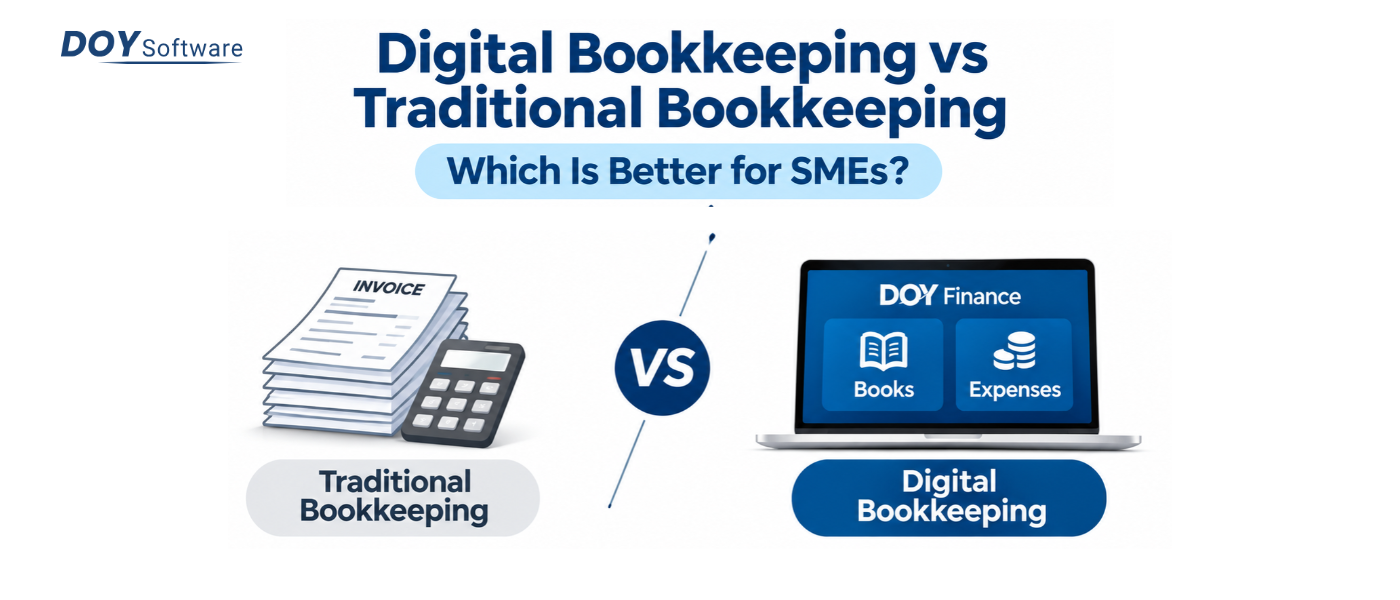
Every small business needs to know where its money comes from and where it goes. That is what bookkeeping does. But there are now two very different ways to do it: the old way, with paper ledgers and spreadsheets, and the new way, with cloud-based accounting software. If you run a small or medium-sized enterprise (SME), choosing between them can affect your time, your costs and even your growth. Let's compare them in plain language.
What Is Traditional Bookkeeping?
Traditional bookkeeping means recording financial transactions by hand or with basic tools. This usually includes paper ledgers, cash books, physical receipt files, and sometimes simple Excel sheets. A bookkeeper or the owner records every sale, purchase, and expense, then totals the figures at the end of the month. Many shops, workshops and family businesses have used this method for decades. It is familiar, it needs no internet, and it costs almost nothing to start. However, it depends entirely on human effort, and that is where problems begin.
What Is Digital Bookkeeping?
Digital bookkeeping, also called online bookkeeping or cloud accounting, uses software such as Zoho Books, QuickBooks, Xero, FreshBooks or Tally to record and organise your finances. Bank feeds can import transactions automatically. Invoices are created and sent in seconds. Receipts can be scanned with a phone, and reports are produced with one click.
In short, the software does the repetitive work, so you can focus on running the business.
Key Differences at a Glance
| Feature | Traditional Bookkeeping | Digital Bookkeeping |
|---|---|---|
| Speed | Slow, manual entry | Fast, mostly automated |
| Accuracy | Higher risk of human error | Fewer errors, built-in checks |
| Upfront cost | Very low | Small monthly subscription |
| Access | Only where the books are kept | Anywhere, on phone or laptop |
| Reports | Prepared by hand | Instant, real-time |
| Security | Can be lost, burnt or stolen | Encrypted, with cloud backups |
| Tax and GST filing | Time-consuming | Simplified and often automated |
| Growth | Gets harder as volume rises | Scales easily |
1. Speed and Efficiency
Writing every transaction by hand takes hours each week. Digital tools cut that time sharply. Recurring invoices, automatic bank reconciliation and instant payment reminders mean tasks that took a full day can take minutes. For an SME with a small team, saved time is saved money.
2. Accuracy and Fewer Mistakes
A misplaced decimal or a forgotten entry can throw off your whole month. Digital bookkeeping reduces these risks through automatic calculations, duplicate-entry alerts and bank matching. Accurate records help you make better decisions and avoid costly corrections later.
3. Cost: What Will You Actually Pay?
Traditional bookkeeping looks cheaper at first because you only buy books and pens. But the hidden costs add up: staff hours, correction time, storage space, and the cost of late or incorrect filings. Digital bookkeeping charges a monthly or yearly fee, often a few hundred to a few thousand rupees depending on the plan, yet it usually saves more than it costs through reduced labour and fewer penalties.
4. Real-Time Financial Insight
With paper books, you may only learn how your business is doing weeks after the month ends. Digital systems show cash flow, profit and loss, outstanding invoices, and expenses at any moment. This real-time view helps you spot problems early, such as customers who pay late, and plan ahead with confidence.
5. Accessibility and Remote Work
Traditional records stay in one place. If you are travelling or working from home, you cannot reach them. Cloud-based bookkeeping lets you and your accountant log in from anywhere. Sharing data is simple, so there is no need to carry files or wait for someone to send them.
6. Security and Data Protection
Paper records can be lost, damaged by water or fire, or read by the wrong person. Digital platforms use passwords, encryption, user permissions and automatic backups. You can decide who sees what, and your data survives even if your laptop breaks.
7. Tax Compliance and Audits
Tax season is stressful when receipts are scattered. Digital bookkeeping keeps documents organised, calculates tax and GST, and creates audit-ready reports. In India and many other countries, e-invoicing and online filing are becoming standard, so digital records fit naturally with these requirements.
8. Scalability
A home-run shop with ten transactions a day may manage on paper. But as sales, staff, and customers grow, manual books become slow and messy. Digital systems grow with you. You can add users, connect payment gateways and track inventory without starting over.
Read More: Internal vs External Financial Reporting: Key Differences Every European SME Should Know
When Does Traditional Bookkeeping Still Make Sense?
Traditional methods are not useless. They can suit:
- Very small businesses with only a few transactions a week
- Areas with poor or unreliable internet
- Owners who are not yet comfortable with technology
Even then, many businesses keep a simple spreadsheet as a stepping stone toward full digital tools.
The Downsides of Digital Bookkeeping
To be fair, digital bookkeeping is not perfect. You need a device and internet access. There is a learning curve at the start, and subscription fees are charged monthly. Choosing a poor-quality tool can also cause frustration. These issues are usually small compared with the benefits, and most platforms offer free trials and customer support.
Final Thoughts
Bookkeeping is the foundation of a healthy business. Traditional methods built that foundation for generations, but today's digital tools make it faster, safer and smarter. For SMEs that want to save time, reduce errors and grow with confidence, moving to digital bookkeeping is one of the most practical steps you can take.